How to Design Wellness Programs for Companies That Actually Work

Medically reviewed by Allison Lane, MD
Allison Lane • March 4, 2026

Table of Contents
- Why Most Wellness Programs for Companies Fall Short (And What Actually Works)
- The Business Case for Wellness Programs for Companies
- Core Components of a Modern Workplace Wellness Strategy
- Innovative Wellness Program Ideas and Activities
- A 7-Step Roadmap to Implementing Your Program
- Measuring Success and Overcoming Implementation Challenges
- Frequently Asked Questions about Wellness Programs for Companies
- Conclusion
Why Most Wellness Programs for Companies Fall Short (And What Actually Works)
Wellness programs for companies are employer-sponsored initiatives that support the physical, mental, financial, and emotional health of employees — and when done right, they deliver measurable results for both people and the bottom line.
Here's a quick look at what effective workplace wellness programs include:
| Component | Examples |
|---|---|
| Physical health | Fitness challenges, flu shot clinics, ergonomic assessments |
| Mental health | Counselling access, mindfulness sessions, burnout prevention |
| Nutrition | Healthy snacks, cooking demos, hydration initiatives |
| Financial wellness | Budgeting workshops, retirement planning, debt management |
| Work-life balance | Flexible scheduling, disconnect policies, nap rooms |
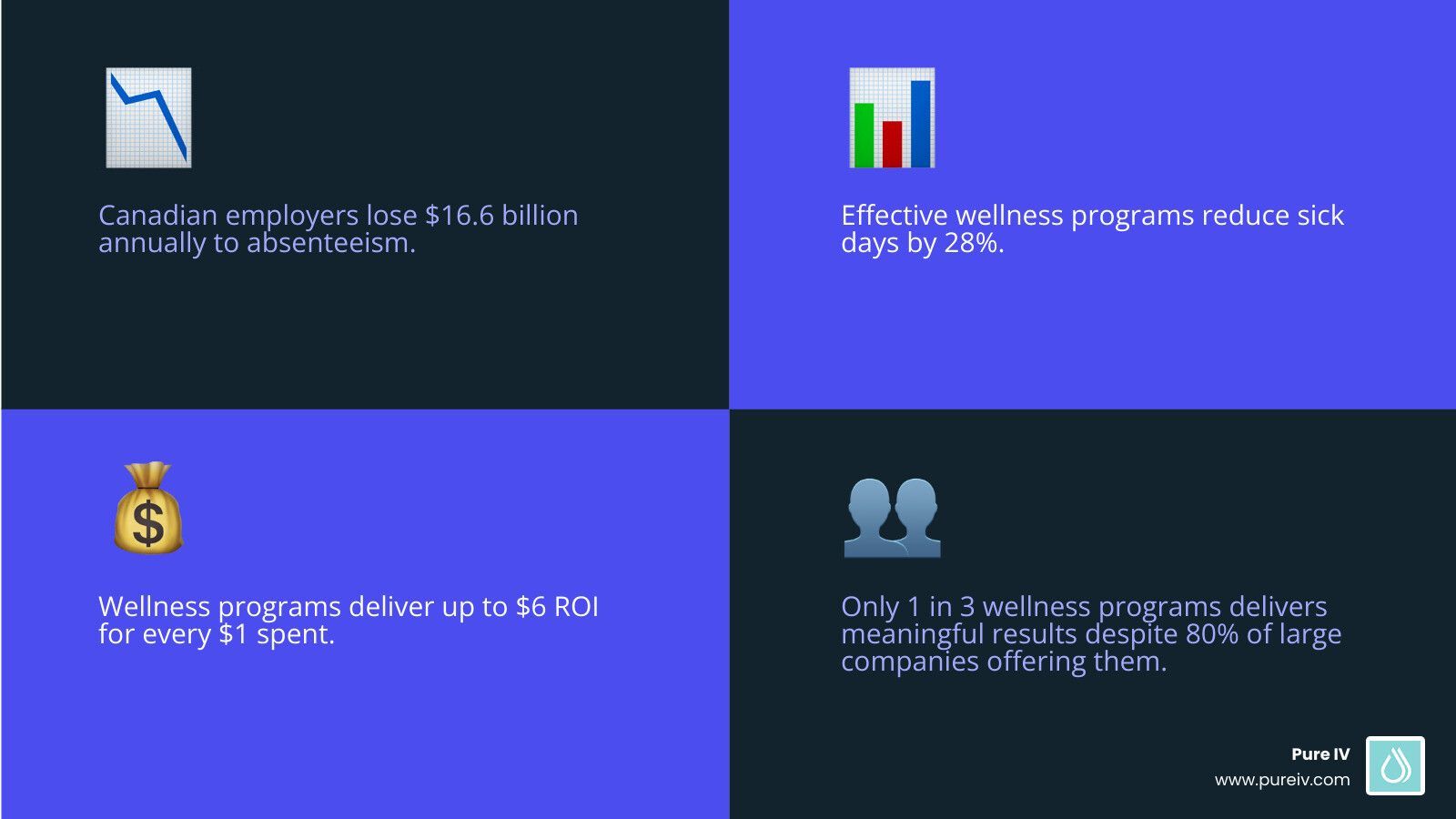
The numbers are hard to ignore. Canadian employers lose roughly $16.6 billion annually to absenteeism alone. Companies with effective wellness programs report a 28% reduction in sick days, a 26% drop in healthcare costs, and up to $6 back for every $1 spent. Yet despite 80% of large Canadian companies offering some form of wellness program, only about one-third actually deliver meaningful results.
The gap between having a wellness program and running one that works is significant. Most programs fail not because wellness doesn't work — but because they're designed without employee input, treat everyone the same, or focus narrowly on physical health while ignoring mental and financial well-being.
This guide walks you through how to build something better.
I'm Dr. Allison Lane, board-certified emergency medicine physician and Medical Director at Pure IV, with over 15 years of clinical experience in sports, emergency, and occupational health settings — experience that gives me a grounded, evidence-based perspective on designing wellness programs for companies that go beyond the basics. Let's get into it.
The Business Case for Wellness Programs for Companies
In the modern business landscape, employee health is no longer a "nice-to-have" perk; it is a strategic imperative. When we look at the data, the financial argument for robust wellness programs for companies becomes undeniable. Beyond the moral obligation to care for the people who drive your business, there is a clear correlation between a healthy workforce and a healthy balance sheet.
Absenteeism is one of the most visible drains on corporate resources. When employees are unwell, they can't show up. However, an even more insidious issue is "presenteeism"—when employees are physically at their desks but mentally disengaged or physically limited due to poor health. Effective wellness initiatives tackle both. According to a 2021 report from Aon on employee wellbeing , there is a renewed urgency among employers to provide holistic solutions as employees increasingly look to their workplaces for health support.
The Return on Investment (ROI) for these programs is well-documented. Research shows that companies with effective programs see a 30% reduction in workers’ compensation and disability claims. When you reduce the frequency of illness and injury, you aren't just saving on direct medical costs; you are preserving the institutional knowledge and productivity that walks out the door every time an employee takes a sick day.
The Financial Impact of Employee Health
Poor employee health creates a ripple effect of costs. High medical and disability claims lead to rising insurance premiums for the organization. But the costs aren't always found in a line item on an insurance bill.
Chronic conditions, which account for a staggering 86% of total medical costs in some regions, are often preventable through lifestyle interventions. Data from the Cost of poor health data suggests that lost productivity due to chronic disease and injury costs employers hundreds of billions annually. By investing in preventive care—such as hydration, nutrition, and stress management—companies can mitigate these long-term financial risks.
Boosting Morale and Job Satisfaction
Beyond the dollars and cents, wellness programs fundamentally reshape workplace culture. A survey from Benefits Canada on workplace culture revealed that 91% of employees in wellness-supportive environments are satisfied with their jobs.
When an organization prioritizes health, it sends a powerful message: "We value you as a person, not just a unit of production." This fosters psychological safety and allows employees to bring their "authentic selves" to work. In a competitive talent market, this level of care becomes a primary driver for talent attraction and long-term employee loyalty.

Core Components of a Modern Workplace Wellness Strategy
A "modern" strategy must be holistic. The days of just offering a discounted gym membership are over. Today’s wellness programs for companies must address the "whole person." This means integrating mental health, physical fitness, nutrition, financial wellness, and work-life balance into a single, cohesive framework.
The CDC Work@Health Program Curricula emphasizes that science-based programs are the most effective at preventing chronic disease and improving quality of life. We like to think of this as a wellness wheel: if one spoke is missing—say, financial health—the whole wheel wobbles, affecting the employee's performance in every other area.
Addressing Mental Health and Stress Management
Mental health has emerged as the most critical focus area for modern employers. With 44% of workers reporting they have experienced a mental health issue, silence is no longer an option. Effective programs include burnout prevention, resilience training, and easy access to professional counselling.
One simple but effective tool is the implementation of "mindfulness moments." A Mayo Clinic report on meditation breaks suggests that even short periods of quiet time can help teams manage stress, refocus, and improve sleep. Reducing the stigma around mental health starts at the top; when leaders speak openly about these resources, participation rates jump significantly.
Physical Health and Preventive Care
Physical wellness is the foundation of productivity. This includes traditional elements like biometric screenings and flu shot clinics, but it also extends to how we support the body's daily needs. Access to primary care is vital, but so is making that care convenient.
At Pure IV, we see how mobile healthcare is changing the game. Instead of employees taking half a day off to visit a clinic, we bring the clinic to them. Whether it's through A Guide to the Best IV Drips for Your Immune Defense to keep the team resilient during flu season or conducting ergonomic assessments to prevent back pain, preventive care should be proactive, not reactive.
Innovative Wellness Program Ideas and Activities
If you want high engagement, you have to make wellness fun and accessible. Generic advice rarely sticks; interactive and experiential activities do.
- Walking Meetings: Research shows that walking enhances creativity. Swap the conference room for a stroll around the block.
- Healthy Potlucks: Encourage team members to share their favorite nutritious recipes.
- On-Site Wellness Pop-Ups: Bring in professionals for a day of rejuvenation. This is where we often help out, providing Wellness Delivered: Everything About Mobile IV Vitamin Therapy At Home or at the office.
- Fitness Challenges: Use wearable tech for friendly office-wide step challenges.
- Rejuvenation Zones: Convert an unused office into a "no-work" lounge with comfortable seating, plants, and perhaps even a nap pod.
Nutrition and Hydration Initiatives
What your employees consume directly impacts their cognitive function. Replacing vending machine soda with sparkling water and fresh fruit is a start, but education is better.
Hydration is often the most overlooked aspect of workplace health. Dehydration leads to brain fog, fatigue, and headaches. Initiatives like water intake challenges or providing IV for Energy: Unpacking the Benefits of Intravenous Revitalization during high-stress project deadlines can keep energy levels stable and focus sharp.
Financial Literacy and Support
You cannot be "well" if you are stressed about your bank account. Financial stress is a leading cause of distraction at work. A financial wellness challenge can help employees build better habits in a low-pressure environment. Offering workshops on debt management, retirement planning, and basic budgeting shows employees that you care about their future stability, not just their current output.
A 7-Step Roadmap to Implementing Your Program
Launching wellness programs for companies requires a structured approach. You can't just throw a bunch of ideas at the wall and see what sticks.
- Secure Leadership Buy-In: If the CEO isn't participating, the employees won't either. Leaders must be visible champions.
- Form a Wellness Committee: Gather a diverse group of employees from different departments and levels to lead the charge.
- Conduct a Needs Assessment: Use anonymous surveys to find out what your employees actually want. Don't guess.
- Design the Program: Based on the data, choose 2-3 high-impact areas to start. This might include scheduling Everything You Need to Know About Professional IV House Calls for your executive team or setting up a mental health app for everyone.
- Develop a Communication Strategy: Use Slack, email, and physical posters to build excitement.
- Launch: Start with a "Wellness Kickoff" event to set the tone.
- Evaluate and Adjust: Collect feedback regularly and be willing to pivot if an initiative isn't landing.
Personalizing Programs for Diverse Demographics
A one-size-fits-all approach is a recipe for failure. Your program must be inclusive of remote workers, hybrid teams, and shift workers.
For those in our service areas like Phoenix, Las Vegas, or Nashville, you might offer the option for employees to visit The Best Local IV Drip Clinics for a Quick Wellness Boost or have a nurse come to their home. For remote teams, consider virtual fitness classes or digital "coffee breaks" that focus on social connection rather than work tasks.
Measuring Success and Overcoming Implementation Challenges
How do you know if your investment is working? You need to track both quantitative and qualitative metrics.
| Metric Type | What to Track |
|---|---|
| Quantitative | Absenteeism rates, healthcare spend, turnover percentages, participation rates |
| Qualitative | Employee satisfaction surveys, pulse checks, testimonials, eNPS scores |
Common challenges include budget constraints and time limitations. The best way to overcome these is to start small. You don't need a million-dollar budget to start a walking club or implement a "right to disconnect" policy after 6 PM. Privacy is another concern; always ensure that individual health data remains confidential and only use aggregate data for program evaluation.
Budgeting and Realistic Investment
What is a realistic investment? Successful wellness programs for companies typically invest between $150 and $350 per employee annually. However, you can start an effective program with as little as $50 per head if you focus on high-impact, low-cost areas like education and policy changes.
Referencing the Research Report on Workplace Wellness Incentives , we see that incentives—like insurance premium discounts or gift cards—can significantly boost participation, but they should be used to foster long-term habit changes rather than just one-time actions.
Frequently Asked Questions about Wellness Programs for Companies
What are the best wellness programs for companies with remote teams?
For remote teams, focus on digital accessibility. Virtual mental health support, ergonomic stipends for home offices, and digital wellness challenges (like a "Step-per-Day" challenge tracked via an app) work best. You can also ship "wellness kits" containing healthy snacks or blue-light-blocking glasses to their homes.
How do you measure the ROI of wellness programs for companies?
The most accurate way is to establish a baseline before you start. Track your absenteeism rates and healthcare claims for 12 months. After implementing your program, compare the new data. Most companies see a meaningful ROI after 18 months, though engagement and morale usually improve within the first 90 days.
What is a realistic budget per employee for a wellness program?
While $150–$350 is the "gold standard" for comprehensive programs, many companies start smaller. The key is consistency. It is better to have a $100-per-employee program that runs year-round than a $500-per-employee "wellness week" that everyone forgets by Monday.
Conclusion
Building a workplace where people truly thrive is about more than just avoiding illness—it's about fostering vitality. When leadership engages and wellness becomes woven into the very fabric of the corporate culture, the results are transformative.
At Pure IV, we are proud to be a part of this shift toward proactive, mobile healthcare. Our Nurse Practitioner-led model ensures that every treatment—from immune-boosting drips to energy revitalization—is handled with the highest level of clinical care. Whether your team is in a high-rise in Denver or working remotely in Salt Lake City, we bring the wellness to you.
Ready to lead the change in your organization? Join our team and drive wellness or reach out today to see how we can help you design a program that actually works.
Dr. Allison Lane is a board-certified physician who focuses on clear communication, patient safety, and personalized treatment plans. She works closely with our team to ensure care is safe based on each person’s medical history, needs, and goals. Her clinical interests include sports medicine, emergency medicine, and tactical medicine.
Dr. Lane has extensive experience providing medical support for athletes and major events. She is the Medical Director for the Tucson Roadrunners and has served as a team physician for University of Arizona athletics and multiple professional and community sports organizations. She also works as a ringside physician for boxing and MMA events.
She’s also active in community service and medical training, helping teach CPR, Narcan use, Stop the Bleed, and basic first aid. At Pure IV, Dr. Lane's focus is on medical compliance, patient safety, and helping scale Pure IV on the medical side.
Education & Training:
- University of Arizona College of Medicine (2010)
- Emergency Medicine Residency, University of Arizona (2013)
- Primary Care Sports Medicine Fellowship, University of Arizona (2014)
Recent Posts