
Vitamin D | The Hormone Disguised as a Vitamin
(and Why You’re Probably Low)
Vitamin D isn’t a vitamin. Not technically. It’s a secosteroid hormone that your body produces when UV-B radiation from sunlight hits your skin. Scientists classified it as a vitamin before they understood its true function, and the name stuck. But calling it a vitamin undersells what it does.
Vitamins are helper molecules. They assist enzymes. Vitamin D doesn’t assist — it commands. It acts as a hormonal signal that regulates gene expression in virtually every tissue in your body. It tells your immune system when to activate and when to stand down. It tells your bones to absorb calcium. It influences your mood, your sleep, your inflammatory response, and your cellular growth.
And roughly 42% of American adults don’t have enough of it.
★★★★★ Trusted by 50,000 satisfied patients
The Sunscreen Paradox and Modern Indoor Life
Your body is designed to produce vitamin D from sunlight. Specifically, UV-B radiation converts 7-dehydrocholesterol in your skin into pre-vitamin D3, which your liver and kidneys then convert into the active hormone (calcitriol, or 1,25-dihydroxyvitamin D).
This system worked perfectly for hundreds of thousands of years. Then modern life broke it:
- We moved indoors. The average American spends over 90% of their time inside. Glass windows block UV-B radiation. Your office, your car, your home — none of them let the vitamin D-producing wavelengths reach your skin.
- We wear sunscreen. SPF 30 blocks approximately 97% of UV-B radiation. That’s the radiation your skin needs to make vitamin D. Sunscreen is absolutely essential for preventing skin cancer and photoaging — but it effectively eliminates vitamin D production.
- Latitude matters. Above the 37th parallel (roughly a line from San Francisco to Richmond, Virginia), UV-B intensity is insufficient for meaningful vitamin D production during winter months (November through February). Denver, Salt Lake City, and Boise — three Pure IV markets — are well above this line.
- Skin pigmentation matters. Melanin (the pigment that gives skin its color) absorbs UV-B radiation. Darker-skinned individuals require significantly more sun exposure to produce the same amount of vitamin D as lighter-skinned individuals. This is a major contributor to higher vitamin D deficiency rates in Black and Hispanic populations.
The result: we’ve engineered a lifestyle that makes it nearly impossible to produce adequate vitamin D naturally for much of the year, in much of the country.
What Happens When Vitamin D Is Low
Your Immune System Loses Its Regulator
Vitamin D doesn’t simply “boost” your immune system. It regulates it. There’s an important difference. Your immune system has two failure modes: too weak (you get sick) and too aggressive (autoimmunity and chronic inflammation). Vitamin D helps prevent both.
Specifically, vitamin D enhances antimicrobial peptides (cathelicidin and defensins) that provide frontline defense against bacteria and viruses. Simultaneously, it modulates T-cell behavior to prevent excessive inflammatory responses. Low vitamin D is associated with increased respiratory infections, higher rates of autoimmune conditions, and prolonged inflammatory responses.
Your Mood Suffers
Vitamin D receptors are present throughout the brain, including in areas involved in mood regulation. Vitamin D participates in serotonin synthesis by activating the gene for tryptophan hydroxylase 2 — the enzyme that produces serotonin in the brain. Low vitamin D is consistently associated with higher rates of depression, and the condition “Seasonal Affective Disorder” (SAD) correlates directly with the winter months when vitamin D production drops.
Your Bones Weaken
Vitamin D’s most well-established role is calcium regulation. Without vitamin D, your intestines absorb only 10–15% of dietary calcium. With adequate vitamin D, absorption increases to 30–40%. Chronic vitamin D deficiency leads to inadequate calcium absorption, which forces your body to pull calcium from your bones to maintain blood calcium levels. Over years, this leads to osteopenia, osteoporosis, and increased fracture risk.
Your Muscles Lose Strength
Vitamin D receptors in skeletal muscle tissue influence muscle fiber composition and function. Vitamin D deficiency is associated with proximal muscle weakness (particularly in the thighs and upper arms), increased fall risk in older adults, and impaired athletic performance.
Vitamin D by Injection — Why We Use IM, Not IV
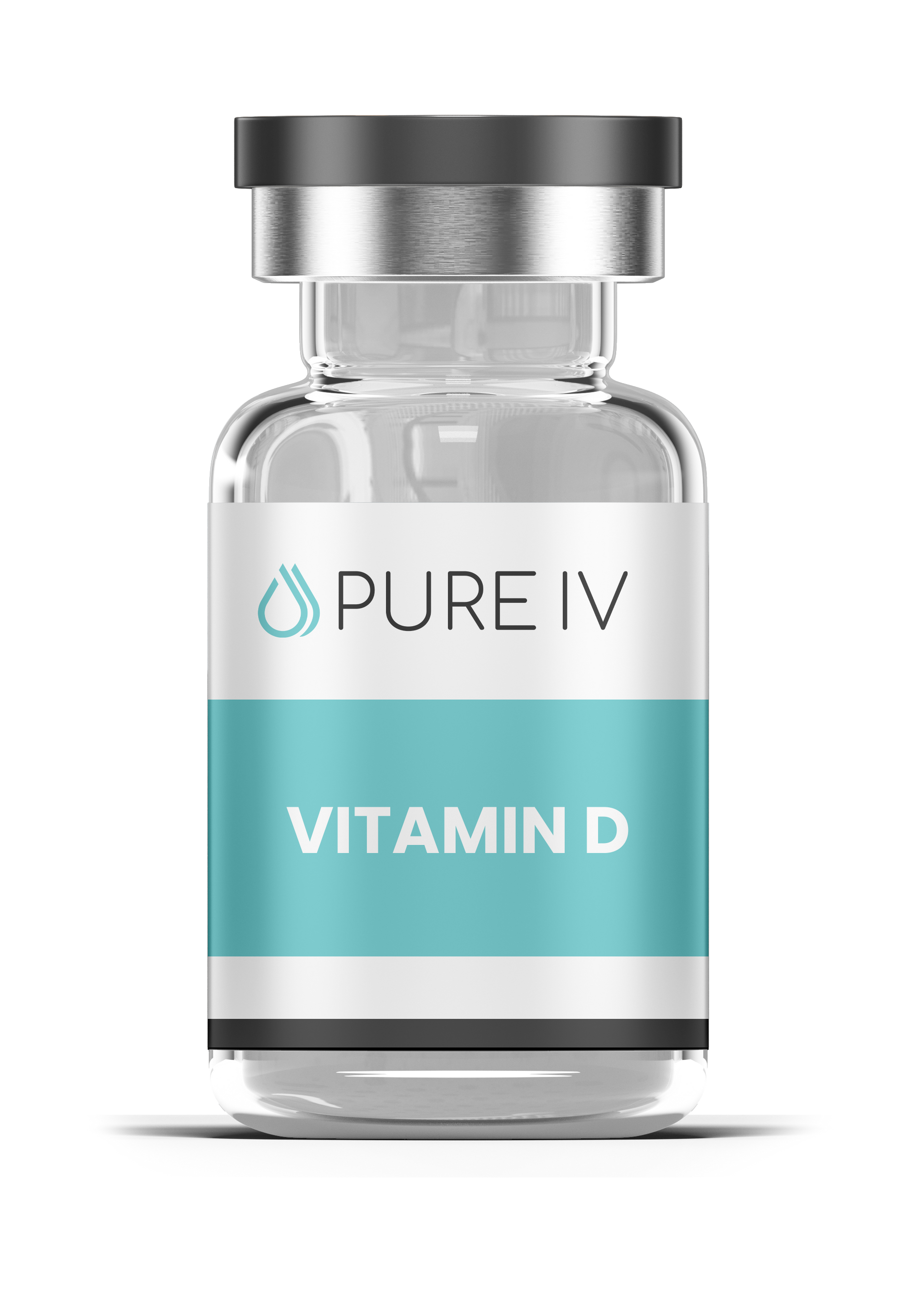
At Pure IV, vitamin D is administered as an intramuscular (IM) injection, not in the IV drip bag. Here’s why:
Vitamin D is fat-soluble. Unlike water-soluble vitamins (C, B complex, B12), vitamin D dissolves in fat, not water. IV saline is a water-based solution. Fat-soluble vitamins don’t mix well into aqueous IV solutions and can precipitate or destabilize other ingredients in the bag.
IM injection provides a depot effect. When vitamin D is injected into muscle tissue, it’s absorbed gradually over days to weeks because it dissolves into the muscle’s fat stores. This creates a sustained-release effect that’s actually more beneficial than a single rapid IV dose. Your body gets a steady supply rather than a spike-and-decline pattern.
The injection is quick — a few seconds, typically in the deltoid (upper arm) or gluteal muscle. It can be administered alongside any IV drip during the same visit.

Vitamin D Supplementation: Oral vs. Injection
| Oral Vitamin D3 (daily) | IM Vitamin D Injection | |
|---|---|---|
| Absorption | Requires dietary fat for absorption. Highly variable. | Consistent absorption from muscle depot. |
| Compliance | Requires daily pill. Many patients forget or stop. | Single injection. Done. |
| Speed to effect | Takes 2–3 months of daily use to significantly change blood levels. | Measurable blood level increase within 1–2 weeks. |
| Measurable blood level increase within 1–2 weeks. | Measurable blood level increase within 1–2 weeks. | Rapid correction of deficiency, patients who don’t take pills consistently, patients with GI absorption issues |
| Frequency | Daily | Monthly to quarterly depending on levels |
Who Needs Vitamin D Most
- People who work indoors. Which is most of the American workforce. If you leave for work before sunrise and come home after sunset during winter months, your vitamin D production is effectively zero.
- People in northern markets. Denver, Salt Lake City, Boise — winter UV-B is insufficient. Even Phoenix residents who stay indoors and wear sunscreen may be deficient despite the sunshine.
- Darker-skinned individuals. Higher melanin levels require 3–6 times more sun exposure for equivalent vitamin D production.
- Older adults. Skin’s vitamin D production capacity decreases with age. A 70-year-old produces approximately 75% less vitamin D from the same sun exposure as a 20-year-old.
- Overweight and obese individuals. Vitamin D is sequestered in adipose tissue (body fat). Higher body fat means more vitamin D gets “trapped” in fat stores rather than circulating in the blood.
- People with GI conditions.
Fat malabsorption conditions (Crohn’s, celiac, cystic fibrosis, liver disease) impair oral vitamin D absorption because it requires dietary fat for uptake.
Which Pure IV Packages Include This
| Package | Price | Notes |
|---|---|---|
| Available as IM injection add-on | Varies | Add a vitamin D injection to any IV visit |
| Immune packages | Immune packages | Particularly complementary with Immune Boost and Cold & Flu IVs |
FAQ's
Frequently Asked Questions
How do I know if I’m deficient?
A 25-hydroxyvitamin D blood test (25(OH)D) is the standard screening. Levels below 20 ng/mL are considered deficient. Levels between 20–30 ng/mL are insufficient. Most experts recommend levels of 40–60 ng/mL for optimal function. Ask your primary care doctor to include this in your next blood panel — it’s a simple, inexpensive test.
Can I get too much vitamin D?
Yes, vitamin D toxicity is possible because it’s fat-soluble and accumulates in body fat. Toxicity is rare and typically occurs only with prolonged high-dose supplementation (above 10,000 IU daily for extended periods) without monitoring. Symptoms include nausea, vomiting, weakness, and dangerously elevated calcium levels. Our NP recommends periodic blood level checks if you’re receiving regular vitamin D injections.
Should I stop taking my daily vitamin D supplement if I get the injection?
Discuss your current supplementation with your NP. In many cases, patients can continue a maintenance oral dose alongside periodic injections, but the NP may adjust your regimen based on your blood levels and injection frequency.
Why an injection instead of adding vitamin D to my IV bag?
Vitamin D is fat-soluble and doesn’t mix well into water-based IV solutions. An IM injection deposits the vitamin D into muscle tissue where it absorbs gradually over days to weeks, providing sustained benefit rather than a single spike. This is actually the medically preferred delivery method for vitamin D supplementation outside of the oral route.