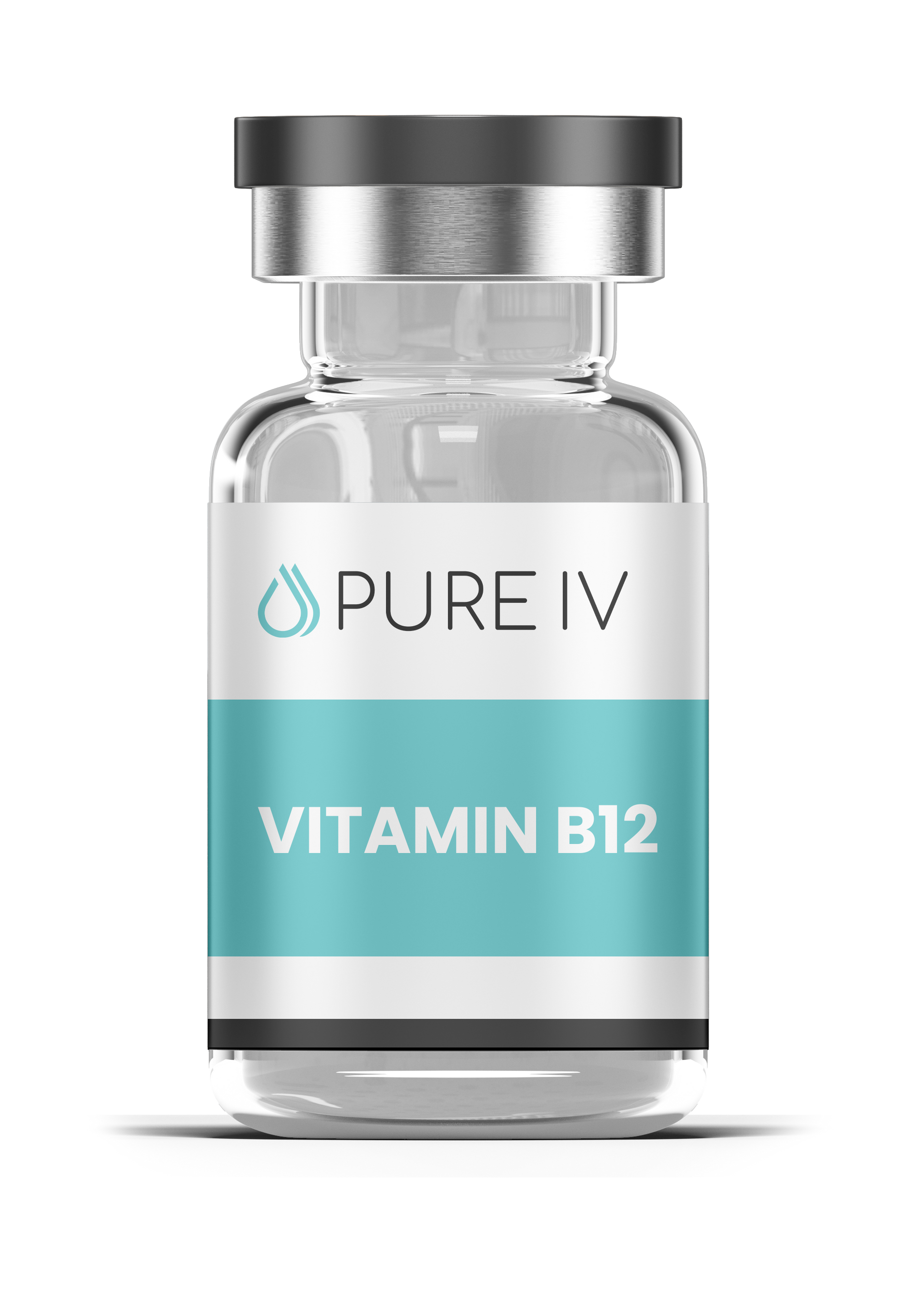
Vitamin B12 IV Therapy | The Vitamin 40% of Americans May Be Missing
Vitamin B12 might be the most commonly deficient nutrient in the developed world. Studies suggest that up to 40% of Americans have blood B12 levels in the low-normal range — not low enough for a clinical diagnosis, but low enough to affect how they feel and function every day.
The symptoms are frustratingly vague: fatigue, brain fog, mood changes, poor memory, tingling in your hands and feet. They overlap with a dozen other conditions, which is why B12 deficiency often goes undiagnosed for years.
And here’s the twist: even if you eat plenty of B12-rich foods, your body might not be absorbing it.
★★★★★ Trusted by 50,000 satisfied patients
What Does B12 Actually Do?
Vitamin B12 (cobalamin) is involved in three essential processes:
1. Energy production
B12 is a cofactor for the enzyme methylmalonyl-CoA mutase, which converts certain fats and amino acids into succinyl-CoA — a molecule that enters the citric acid cycle (Krebs cycle) to produce ATP. Without B12, this conversion stalls. Your cells still produce energy, but less efficiently. The result feels like running your car on 4 cylinders instead of 6: you’re moving, but everything requires more effort.
2. Nerve protection
B12 is essential for producing myelin — the fatty sheath that wraps around your nerve fibers and enables electrical impulses to travel quickly and accurately. Think of myelin like the insulation on an electrical wire. Without it, signals travel slowly, misfire, or don’t reach their destination. This is why B12 deficiency causes tingling, numbness, balance problems, and eventually permanent nerve damage if left untreated.
3. Red blood cell formation
B12 is required for DNA synthesis in rapidly dividing cells — and your bone marrow produces approximately 200 billion new red blood cells every day. Without enough B12, these cells can’t divide properly. They become abnormally large (megaloblastic) and can’t carry oxygen efficiently. This condition — megaloblastic anemia — causes fatigue, weakness, and shortness of breath.
Bonus: Homocysteine regulation
B12 converts homocysteine (an amino acid associated with cardiovascular risk) into methionine. Low B12 levels allow homocysteine to accumulate, which is associated with increased risk of heart disease and stroke.
Why B12 Deficiency Is So Common
B12 has the most complicated absorption pathway of any vitamin. Most vitamins absorb passively through your intestinal lining. B12 requires a multi-step active transport process:
Step 1
Your stomach acid separates B12 from the protein it’s bound to in food.
Step 2
Free B12 binds to a protein called intrinsic factor, produced by parietal cells in your stomach lining.
Step 3
The B12-intrinsic factor complex travels to the ileum (the last section of your small intestine).
Step 4
Specialized receptors in the ileum absorb the complex into your bloodstream.
If ANY step in this chain fails, B12 doesn’t get absorbed. And multiple common conditions break this chain:
| Condition | Which Step Breaks | Who’s Affected |
|---|---|---|
| Low stomach acid | Step 1 — can’t separate B12 from food protein | Adults over 50, PPI users (Omeprazole, Nexium, Prilosec), H2 blocker users (Anti-heartburn) |
| Parietal cell damage | Step 2 — can’t produce intrinsic factor | Autoimmune gastritis, H. pylori infection, chronic alcohol use |
| Pernicious anemia | Step 2 — antibodies destroy intrinsic factor | Autoimmune condition, affects ~1-2% of adults over 60 |
| Small intestine disease | Step 4 — ileum can’t absorb the complex | Crohn’s disease, celiac disease, SIBO, surgical removal of ileum |
| Metformin use | Steps 3-4 — alters calcium-dependent absorption | Type 2 diabetes patients on metformin (180+ million prescriptions/year in the US) |
| Vegan/vegetarian diet | Step 0 — no B12 in plant foods | B12 is only found naturally in animal products |
The PPI connection is huge. Over 15 million Americans take proton pump inhibitors (Omeprazole, Nexium, Prilosec) for acid reflux. These medications reduce stomach acid by up to 95%. Without stomach acid, B12 can’t be separated from food protein — Step 1 fails. Long-term PPI use is strongly associated with B12 deficiency, but most patients are never told to monitor their B12 levels.
Why IV B12 Bypasses Every Absorption Problem
IV B12 skips the entire 4-step absorption process. It goes directly into your bloodstream. No stomach acid needed. No intrinsic factor needed. No ileum absorption needed. No matter what’s wrong with your gut, the B12 reaches your cells.
This is why IV and intramuscular B12 are the standard medical treatments for pernicious anemia and severe deficiency — oral supplementation simply can’t work when the absorption pathway is broken.
Signs You Might Be Low on B12
B12 deficiency develops slowly because your liver stores 2–5 years’ worth of B12. This means you can be depleting your stores for months or years before symptoms appear. By the time symptoms are noticeable, your levels may be significantly low.
Fatigue that sleep doesn’t fix.
The ‘tired all the time’ feeling that persists no matter how much you rest. Your cells aren’t producing energy efficiently.
Brain fog and poor memory
Difficulty concentrating, forgetfulness, ‘fuzzy thinking.’ B12 is critical for neurotransmitter production and nerve function in the brain.
Mood changes
Depression, anxiety, irritability. B12 is involved in serotonin and dopamine production.
Tingling or numbness in hands and feet
This is peripheral neuropathy from myelin degradation. It’s a later-stage symptom that indicates significant deficiency. If left untreated, nerve damage can become permanent.
Pale or slightly yellow skin
From reduced red blood cell production and the breakdown of fragile, oversized red blood cells.
Balance problems
Myelin degradation in the spinal cord affects proprioception (your sense of where your body is in space). This can cause unsteadiness and coordination issues, particularly in older adults.

Methylcobalamin vs. Cyanocobalamin — Which Form of B12?
There are several forms of B12. The two most common in supplements and IV therapy are:
- Cyanocobalamin: The synthetic form. Stable, inexpensive, well-studied. Your body converts it to the active forms (methylcobalamin and adenosylcobalamin) after absorption. The conversion is efficient in most people.
- Methylcobalamin: One of the two active forms. Doesn’t require conversion. Some practitioners prefer it for patients with MTHFR gene variants that may slow the conversion of cyanocobalamin.
Both forms are effective for most patients. The difference is less important than the delivery method (IV vs oral) and whether you’re actually absorbing it.
Which Pure IV Packages Contain This Ingredient
| Package | Price | Best For |
|---|---|---|
| Myers Cocktail | $250 | B12 + B Complex + full vitamin/antioxidant formula |
| Energy Boost | $220 | B12 for energy + vitamin C + amino blend |
| Mega Myers | $325 | Higher-dose B12 in enhanced Myers formula |
| Nearly every Pure IV package | Varies | B12 is included in almost all packages alongside B Complex |
Think you might be low on B12? Explore our packages.
FAQ's
Frequently Asked Questions
How do I know if I’m deficient in B12?
A simple blood test (serum B12 level) can check your status. Levels below 200 pg/mL are considered deficient. Levels between 200–400 pg/mL are in the ‘gray zone’ where many people experience symptoms. Ask your doctor to test your B12 level — it’s a standard blood panel addition. A more sensitive test (methylmalonic acid) can detect functional deficiency even when serum B12 appears normal.
Can I just take B12 pills instead?
If your absorption pathway is intact, oral B12 supplements work for maintenance. But if you have any condition that impairs absorption (low stomach acid, PPI use, pernicious anemia, gut disease), oral supplements may not be effective. IV B12 bypasses every absorption barrier.
How often should I get B12 IV therapy?
For significant deficiency, an initial series of weekly infusions followed by monthly maintenance is common. For general wellness, monthly B12 as part of a Myers Cocktail or similar package provides consistent support. Your provider can adjust frequency based on your blood levels and how you respond.
Is B12 the same as B Complex?
No. B Complex contains B1, B2, B3, B5, and B6. B12 is a separate vitamin not included in B Complex. Most Pure IV packages include both B Complex AND B12 because they serve different functions. See our B Complex ingredient page for details on those five vitamins.