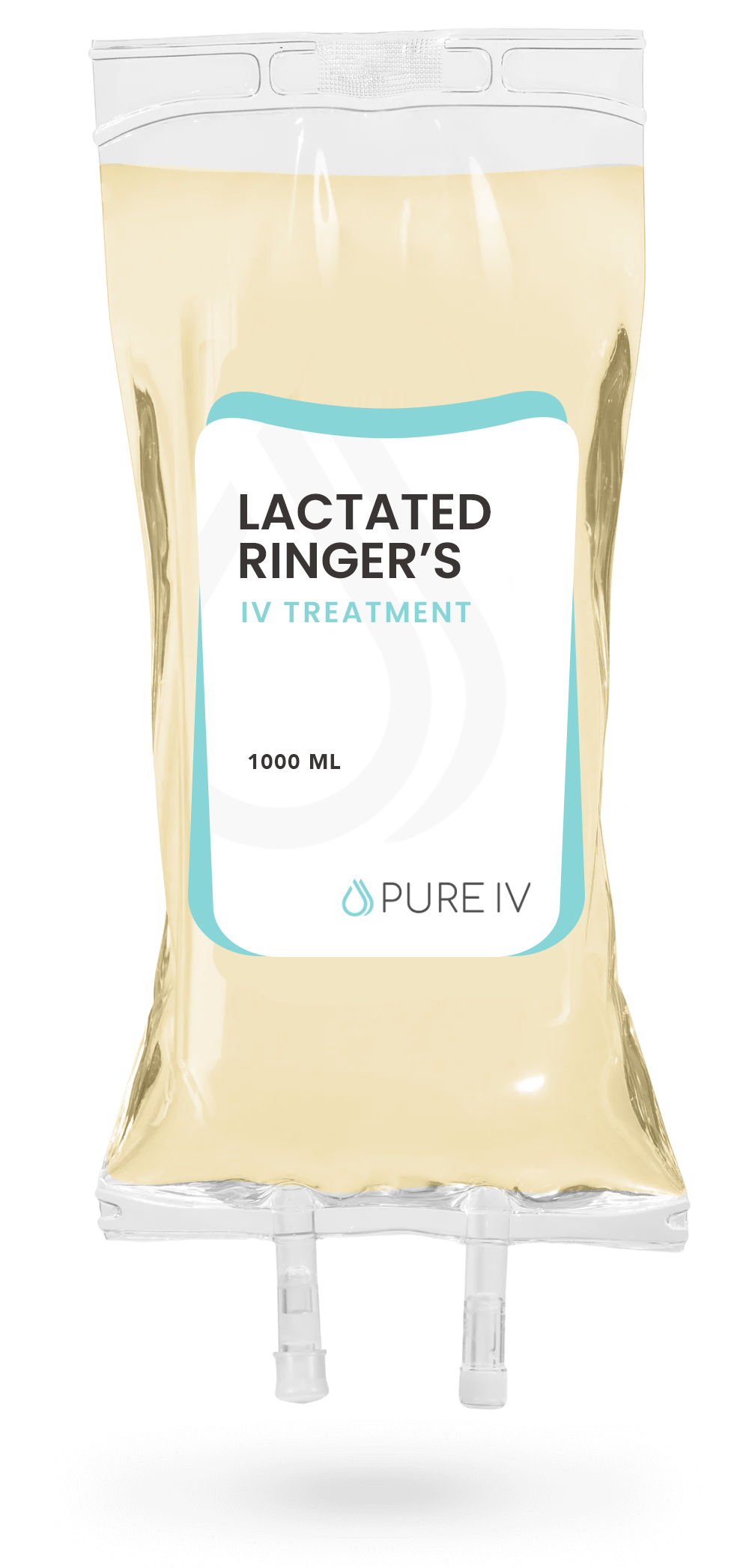
Lactated Ringer’s IV
If you’ve ever received an IV — at a hospital, an urgent care, or through a mobile IV service — you probably got normal saline. It’s been the default IV fluid in American medicine for over a century. Bags of it line the shelves of every ER, every ambulance, every clinic.
But over the past decade, something has been shifting in hospitals. Emergency departments, ICUs, and surgical suites are increasingly reaching for a different bag: Lactated Ringer’s solution. Multiple large clinical trials have raised the question of whether the fluid we’ve used by default for a hundred years might not be the best choice for every patient.
This page explains what Lactated Ringer’s is, how it differs from normal saline, what the research says, and how Pure IV decides which fluid to use for your treatment.
★★★★★ Trusted by 50,000 satisfied patients
A Brief History — How Normal Saline Became the Default
In the 1890s, a Dutch physiologist named Hartog Jakob Hamburger developed 0.9% sodium chloride solution — what we now call “normal saline.” He matched the salt concentration to the aqueous phase of human blood plasma, creating a fluid that wouldn’t cause red blood cells to swell or shrink when mixed with blood. It entered clinical practice in the 1910s and quickly became ubiquitous.
About forty years later, an American pediatrician named Alexis Hartmann modified an earlier solution developed by British physiologist Sydney Ringer. Hartmann added sodium lactate to Ringer’s original electrolyte mix, creating what we now call Lactated Ringer’s solution (also known as Hartmann’s solution). He designed it specifically to treat acidosis in children with diarrheal dehydration.
Despite being developed as a more physiologically complete fluid, Lactated Ringer’s never displaced normal saline as the default. Normal saline was simpler, cheaper, had a longer shelf life, and was compatible with more medications. Habit, logistics, and cost kept normal saline in pole position for decades.
That’s changing now — and the reason is data.
What’s in Each Fluid — The Composition Comparison
| Component | Your Blood Plasma | Normal Saline (0.9% NaCl) | Lactated Ringer’s |
|---|---|---|---|
| Sodium (Na⁺) | 136–145 mEq/L | 154 mEq/L | 130 mEq/L |
| Chloride (Cl⁻) | 98–106 mEq/L | 154 mEq/L | 109 mEq/L |
| Potassium (K⁺) | 3.5–5.0 mEq/L | 0 mEq/L | 4 mEq/L |
| Calcium (Ca²⁺) | 4.5–5.5 mEq/L | 0 mEq/L | 3 mEq/L |
| Lactate (buffer) | 0.5–1.5 mmol/L | 0 mmol/L | 28 mmol/L |
| pH | 7.35–7.45 | 5.0–5.5 (acidic) | 6.0–7.5 |
| Osmolarity | 275–295 mOsm/L | 308 mOsm/L | 273 mOsm/L |
Look at the chloride row. That’s where the story gets interesting.
The Chloride Problem With Normal Saline
Normal saline contains 154 mEq/L of chloride. Your blood plasma contains 98–106 mEq/L. That means normal saline delivers roughly 50% more chloride than your blood naturally contains.
When you infuse a liter of normal saline, that excess chloride has to go somewhere. Here’s what happens:
Hyperchloremia
Hyperchloremia
Metabolic acidosis.
Excess chloride displaces bicarbonate (your body’s primary blood buffer), lowering your blood pH. This is called hyperchloremic metabolic acidosis. It’s a real, measurable biochemical change that occurs with high-volume normal saline infusion.
Reduced kidney blood flow.
Animal studies and some human data suggest that excess chloride causes constriction of the renal afferent arterioles — the tiny blood vessels that bring blood into your kidneys for filtering. Less blood flow to the kidneys means less filtration, which can slow urine output and impair waste clearance.
For a single liter of normal saline during a routine IV therapy session, are these effects clinically significant? For most healthy adults, probably not in a meaningful way. Your kidneys handle the extra chloride efficiently, and the metabolic acidosis is mild and self-correcting.
But the question the research community has been asking is: if we have a fluid that doesn’t create these effects in the first place, why not use it?

How Lactated Ringer’s Avoids the Chloride Problem
Lactated Ringer’s contains 109 mEq/L of chloride — much closer to your plasma’s natural 98–106 mEq/L range. It replaces some of the chloride with lactate (28 mmol/L), which serves as a buffering agent.
Wait — lactate? Doesn’t that cause lactic acidosis?
No. This is one of the most persistent misconceptions in medicine. The lactate in Lactated Ringer’s is sodium lactate, not lactic acid. Your liver rapidly metabolizes sodium lactate into bicarbonate — your body’s natural blood buffer. So instead of adding acid (like the excess chloride in normal saline does), the lactate in LR actually helps maintain or restore your blood’s normal pH.
Think of it this way: normal saline makes your blood slightly more acidic. Lactated Ringer’s helps keep your blood at its natural pH. For most healthy adults, this difference is subtle. For patients who are already stressed, dehydrated, or fighting illness, the difference may matter more.
Lactated Ringer’s Also Contains Electrolytes Normal Saline Doesn’t
Look back at the composition table. Normal saline contains only sodium and chloride. That’s it. Lactated Ringer’s contains:
- Potassium (4 mEq/L). An essential electrolyte for heart rhythm, muscle contraction, and nerve signaling. When you’re dehydrated from vomiting, diarrhea, sweating, or alcohol, you’re losing potassium along with water. Normal saline replaces the water and sodium but not the potassium. LR replaces all three.
- Calcium (3 mEq/L). Required for muscle contraction, nerve transmission, blood clotting, and heart function. Like potassium, calcium is lost during dehydration and not replaced by normal saline.
These are small amounts — not enough to treat a significant electrolyte deficiency on their own. But they contribute to a fluid that more closely resembles what you’ve lost, rather than replacing everything with just salt water.
What the Research Says — The Honest Assessment
Several major clinical trials have compared balanced crystalloids (including Lactated Ringer’s) to normal saline. Here’s what the evidence shows:
The SMART Trial (2018)
Over 15,000 critically ill ICU patients at Vanderbilt University Medical Center. Patients receiving balanced crystalloids (LR or Plasma-Lyte) had a lower rate of a composite outcome including death, new dialysis, and persistent kidney dysfunction compared to those receiving normal saline. The difference was small but statistically significant — about a 1% absolute reduction in major adverse kidney events.
The SALT-ED Trial (2018)
Over 13,000 non-critically ill patients in the same emergency department. Balanced crystalloids showed a modest reduction in major adverse kidney events compared to normal saline. The effect was smaller in this healthier population, which makes sense — healthy kidneys handle the extra chloride more easily.
The CLOVERS Secondary Analysis (2025)
A secondary analysis of a sepsis trial found that patients who received Lactated Ringer’s for initial fluid resuscitation had a lower 90-day mortality rate (12.2%) compared to those who received normal saline (15.9%). The researchers noted an adjusted hazard ratio of 0.71 — suggesting meaningful potential benefit. However, as a secondary analysis (not the primary question the trial was designed to answer), this finding needs confirmation in dedicated prospective trials.
The FLUID Trial (NEJM, 2025)
A large Canadian crossover trial where hospitals alternated between LR and normal saline. The primary outcome (death or readmission within 90 days) did not show a significant difference between fluids. This trial tempered the enthusiasm from earlier studies and suggested that for routine hospitalized patients, the choice of crystalloid may not dramatically affect outcomes.
What This All Means
The honest summary: the evidence suggests a possible modest advantage for balanced crystalloids like LR in certain populations (critically ill, septic, high-volume resuscitation), but does not conclusively prove superiority for every patient in every situation. The medical community is gradually shifting toward balanced crystalloids as a reasonable default, but the debate isn’t settled.
For Pure IV patients — who are generally healthy adults receiving 1 liter of fluid for hydration, wellness, or symptom management — the clinical difference between LR and normal saline is likely small. Both are safe, effective, and appropriate. The choice should be made based on the specific clinical scenario, not marketing.
When Pure IV Chooses Lactated Ringer’s Over Normal Saline
At Pure IV, both normal saline and Lactated Ringer’s are available. Our clinical team selects the appropriate fluid based on the patient’s situation:
Significant dehydration with vomiting or diarrhea. When you’ve lost fluids through vomiting or diarrhea, you’ve lost potassium, calcium, and bicarbonate in addition to water and sodium. LR replaces a broader electrolyte profile than normal saline. It also provides lactate that metabolizes into bicarbonate, helping correct the mild acidosis that vomiting and diarrhea can cause.
Patients who want the closest match to their body’s natural fluid. Some patients specifically request LR because they understand the composition difference. We honor that preference when clinically appropriate.
Post-athletic recovery. Heavy sweating loses a mix of electrolytes, not just sodium. LR’s broader electrolyte profile may be a better match for sweat losses.
Large-volume hydration.
When more than 1 liter of fluid is needed, the chloride load from normal saline accumulates. LR’s lower chloride content becomes more relevant with higher volumes.
When Normal Saline May Be Preferred
LR isn’t always the better choice. Normal saline is preferred in specific situations:
- Medication compatibility. Some medications are incompatible with the calcium in LR. Notably, ceftriaxone (a common antibiotic) can precipitate with calcium-containing fluids. Normal saline is the safer carrier fluid when specific medications are involved.
- Simplicity and stability. Normal saline has a longer shelf life and fewer compatibility concerns. When vitamin and medication add-ins are being mixed into the bag, normal saline’s stability advantages matter.
- Patient preference. Some patients prefer normal saline, some prefer LR. Both are safe and effective for the volumes used in mobile IV therapy. We follow the patient’s preference when either fluid is clinically appropriate.
The key takeaway: the choice between LR and normal saline should be a clinical decision informed by your specific situation, not a marketing slogan. Any IV therapy company that tells you one fluid is universally “better” is oversimplifying the science.
The Lactate Myth — Debunked
Let’s address this directly because it comes up often: “Doesn’t Lactated Ringer’s contain lactic acid? Won’t it give me lactic acidosis?”
No. The lactate in LR is sodium lactate, which is an alkalinizing agent — the opposite of lactic acid. Here’s the pathway:
- Step 1: Sodium lactate enters your bloodstream via the IV.
- Step 2: Your liver converts lactate to pyruvate (via lactate dehydrogenase).
- Step 3: Pyruvate enters the citric acid cycle for energy production OR is converted to bicarbonate.
- Step 4: The bicarbonate buffers your blood, helping maintain normal pH.
The sodium lactate in LR is metabolic fuel, not metabolic waste. Lactic acidosis occurs when your body produces excess lactic acid from anaerobic metabolism (oxygen-deprived tissue, severe illness, shock). The lactate in LR doesn’t contribute to this process.
Multiple studies have confirmed that LR does not worsen lactic acidosis in patients who already have elevated lactate levels. In fact, the acidosis from normal saline’s excess chloride is likely more clinically problematic than any theoretical concern about LR’s lactate content.
Composition Breakdown — What Each Component Does
| Component | Amount in LR | What It Does in Your Body |
|---|---|---|
| Sodium (Na⁺) | 130 mEq/L | Primary extracellular electrolyte. Maintains fluid balance, blood pressure, and nerve signaling. |
| Chloride (Cl⁻) | 109 mEq/L | Partners with sodium for fluid balance. LR’s lower chloride (vs 154 in NS) reduces hyperchloremia risk. |
| Potassium (K⁺) | 4 mEq/L | Essential for heart rhythm, muscle contraction, nerve function. Lost during vomiting, diarrhea, sweating. |
| Calcium (Ca²⁺) | 3 mEq/L | Muscle contraction, nerve transmission, blood clotting, bone health. |
| Sodium Lactate | 28 mmol/L | Metabolized to bicarbonate by liver. Acts as pH buffer. Provides metabolic fuel for cells. |
| Water | Sterile, pyrogen-free | The solvent and delivery vehicle. Provides hydration. |
FAQ's
Frequently Asked Questions
Is Lactated Ringer’s better than normal saline?
Neither fluid is universally “better.” Lactated Ringer’s has a composition closer to your blood plasma, contains additional electrolytes (potassium, calcium), and delivers less chloride. Several large studies suggest modest advantages for balanced crystalloids in specific clinical populations. For routine mobile IV therapy in healthy adults, both are safe and effective. The choice depends on your specific situation, which medications are being administered, and clinical judgment.
Does the lactate in Lactated Ringer’s cause lactic acidosis?
No. The sodium lactate in LR is metabolized by your liver into bicarbonate — a natural blood buffer. It does not contribute to lactic acidosis. This is one of the most common misconceptions in IV fluid therapy, even among some healthcare providers. Multiple studies have confirmed that LR does not worsen lactate levels in patients with existing lactic acidosis.
Why don’t all IV therapy companies use Lactated Ringer’s?
Several practical reasons: normal saline has a longer shelf life, is compatible with more medications, is slightly less expensive, and has been the habitual choice for over a century. LR requires more clinical knowledge to use appropriately (knowing which medications are calcium-incompatible, understanding when LR vs NS is preferred). Companies that use nurses without strong physician oversight may default to normal saline to avoid compatibility issues.
Can I request Lactated Ringer’s for my Pure IV treatment?
Yes. Both normal saline and Lactated Ringer’s are available. Let us know your preference when booking or tell your nurse on arrival. If there’s a clinical reason to use one over the other (medication compatibility, specific medical conditions), your nurse and NP will advise you.
Does Lactated Ringer’s cost more?
No. At Pure IV, the choice between normal saline and Lactated Ringer’s does not affect your price. The fluid is selected based on clinical appropriateness and patient preference, not as an upsell.
I have liver disease. Can I still get Lactated Ringer’s?
Caution is advised. The lactate in LR is metabolized by the liver. Patients with severe liver dysfunction may not process sodium lactate efficiently, potentially leading to lactate accumulation. Our NP evaluates liver function concerns as part of the pre-treatment medical review. Normal saline may be the preferred fluid for patients with significant liver disease.
Can Lactated Ringer’s be used with all IV medications and vitamins?
Most vitamins and supplements are compatible with LR. The main concern is calcium-containing LR and certain medications — most notably ceftriaxone (an antibiotic). Since mobile IV therapy typically doesn’t involve antibiotics, this is rarely an issue. Our clinical team verifies compatibility for every treatment.