Pre-IV Screening and Medical Assessment at Pure IV
★★★★★ Trusted by 50,000 satisfied patients
Physician Owned
Licensed RNs & Paramedics Only
Real-Time NP Oversight
Transparent Pricing
Table of Contents
- Pre-IV Screening and Medical Assessment at Pure IV
- What Is a Good Faith Exam?
- How Pure IV's Pre-Treatment Screening Works: Step by Step
- What Our Medical Team Screens For
- Why This Matters: What Happens When Screening Does Not Happen
- Pure IV's Screening vs. the Industry Standard
- What Happens If the Screening Identifies a Concern
- Red Flags: How to Know If a Provider Is Cutting Corners
- What Are People Saying About Pure IV?
- Frequently Asked Questions
- Your Safety Is Not Optional. It Is Not an Upsell. And It Is Not Something You Should Pay Extra For.
- Ready to Try IV Therapy?
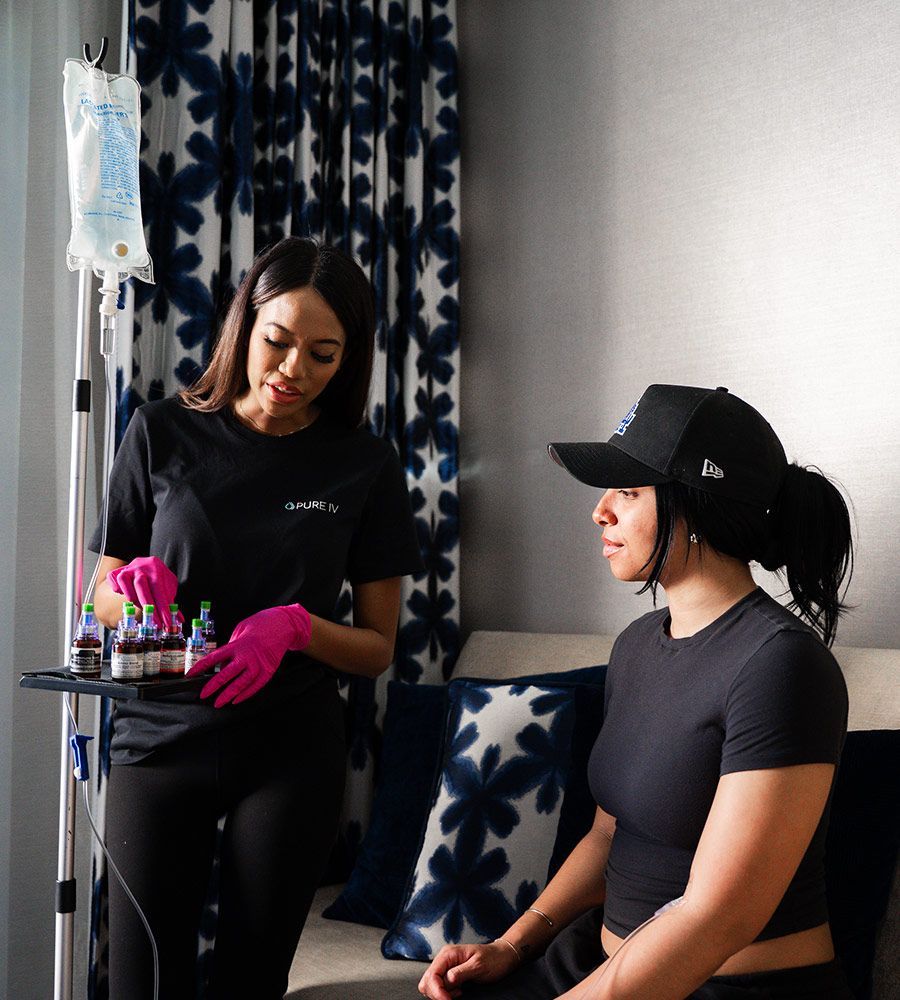
At Pure IV, no needle touches your skin until a Nurse Practitioner has personally spoken with you, reviewed your health, and approved your treatment.
That is not something that happens behind the scenes. It happens with you, live, on the phone. A licensed Nurse Practitioner conducts a real-time televisit with you to assess your health, review your medical history, answer your questions, and approve your specific treatment plan. Your provider is right there with you during this call.
This is called a Good Faith Exam, and it is a legal and medical requirement for any service that involves delivering substances into your body. It is the same type of assessment that takes place before treatment at a hospital, medical spa, or doctor's office. It establishes a formal patient-provider relationship and ensures that a licensed medical professional has evaluated your specific situation before ordering your treatment.
And at Pure IV, this exam is completely free. We do not charge you a separate fee for it. It is built into every appointment because we believe a medical screening should never be treated as an upsell. It is a basic standard of care.
Some IV therapy companies charge $20 to $30 for this exam as a separate fee. Some make that fee non-refundable even if you are denied treatment. Others skip it entirely and operate on standing orders where no provider ever reviews your individual health. At Pure IV, you get a live NP assessment at no charge, every single time.
This page explains exactly what our pre-treatment screening involves, why it matters, and how it protects you.
What Is a Good Faith Exam?
A Good Faith Exam, sometimes called an initial medical assessment, clearance exam, or pre-treatment screening, is a formal medical evaluation performed by a licensed healthcare provider before a patient receives a medical treatment.
The purpose is straightforward. A qualified medical professional needs to review your health and determine that you are a safe candidate for the treatment being offered. This is the medical standard of care. It applies to hospitals, clinics, medical spas, and yes, IV therapy services.
In most states where Pure IV operates, a Good Faith Exam is legally required before administering IV therapy. The exam must be performed or overseen by a licensed provider with prescriptive authority, such as a physician, Nurse Practitioner, or physician assistant. Registered nurses can assist with the exam, but the clinical decision must come from a provider with the authority to order treatment.
The Good Faith Exam has two core components.
Part One: Medical History Review
The provider gathers information about your general health, including your medical conditions both past and present, current medications and supplements, known allergies especially to medications or latex, recent symptoms or changes in your health, past experiences with IV therapy or blood draws, and any conditions that could affect how your body handles IV fluids such as heart disease, kidney disease, or blood clotting disorders.
This information helps the NP understand your unique health picture and identify anything that might make certain IV treatments inappropriate or require dosing adjustments.
Part Two: Live Clinical Assessment
The second component involves a direct interaction between the patient and the licensed provider performing the exam. At Pure IV, this happens live via a real-time phone televisit with our Nurse Practitioner. The NP speaks with you directly, asks follow-up questions about your health intake, discusses any concerns, and evaluates whether the treatment you requested is safe and appropriate for your current condition.
This live interaction is what separates a real Good Faith Exam from a rubber stamp. The NP is not just reviewing a form. They are talking with you, assessing you, and making a clinical decision based on a real conversation.
Your bedside provider also takes your vital signs, including blood pressure, heart rate, and oxygen saturation, before the IV starts. Together, the NP's live assessment and the provider's on-site evaluation give our medical team the information they need to approve your treatment with confidence.
How It Works
How Pure IV's Pre-Treatment Screening Works: Step by Step
Step 1
You Book Your Appointment
When you book online or by phone, you select your treatment package and schedule your appointment time. At this point, the medical screening process is already beginning. Our system captures your basic information and prepares your health intake form for completion.
Step 2
You Complete the Health Intake Form
Before your appointment, you receive a health intake form to fill out. This is not a generic waiver. It is a medical questionnaire that collects the specific information our medical team needs to evaluate your safety.
Read More
The intake form asks about your current medical conditions such as heart disease, kidney disease, diabetes, high blood pressure, liver disease, blood clotting disorders, and autoimmune conditions. It asks about all current medications including prescriptions, over-the-counter drugs, and supplements. It covers your known allergies, especially to medications, adhesives, or latex. It records your current symptoms, meaning the reason you are seeking IV therapy, whether that is dehydration, illness, hangover recovery, wellness maintenance, or something else. It captures your age, weight, and pregnancy status. And it documents any history of adverse reactions to IV therapy, blood draws, or injectable medications.
This form takes about two minutes to complete and can be filled out from your phone before the provider even arrives.
Step 3
Your Live Nurse Practitioner Televisit
This is where Pure IV sets the standard for the entire industry. When your provider arrives at your location, they connect you with our Nurse Practitioner for a live, real-time televisit by phone.
Read More
The NP speaks directly with you. This is not a behind-the-scenes chart review. This is not a form that gets emailed to a doctor for a signature. You are actually talking to a licensed Nurse Practitioner who is evaluating you in real time.
During this live assessment, the NP reviews the health information you submitted on your intake form. They ask you follow-up questions about your medical history, current symptoms, and any concerns. They discuss the treatment you selected and explain what it includes. They evaluate whether the treatment is appropriate for your specific health profile. And if anything needs to be adjusted, such as modifying your formula, changing the dosing, or recommending a different treatment entirely, the NP makes that decision right then and there, during the conversation with you.
The NP then approves your specific treatment plan. This approval is patient-specific and appointment-specific. It is a clinical order tailored to you, not a blanket clearance that was signed weeks ago and applied to every patient who walks through the door.
And here is the part that surprises most people: this entire process is free. Pure IV does not charge you a separate fee for the Good Faith Exam. No $20 screening fee. No $30 telehealth charge. No hidden line item on your receipt. The live NP televisit is included in every appointment because it is not an add-on. It is the standard of care.
Step 4
Bedside Vital Signs and Provider Assessment
While the NP televisit is happening or immediately after, your bedside provider takes your vital signs: blood pressure, heart rate, and oxygen saturation. These baseline measurements confirm that your vitals are within safe ranges to receive IV therapy. They also give the provider reference points to compare against during the infusion if you report any changes in how you feel.
Read More
Your provider also verifies your identity, confirms the treatment that was approved by the NP, and asks if anything has changed since you submitted your health intake. New symptoms, new medications, or anything that came up between booking and your appointment.
If your vitals are outside of normal ranges or if the provider identifies any new concerns, they contact the NP again for guidance before proceeding. In some cases, the provider may determine that IV therapy is not appropriate at that time and will recommend an alternative, such as seeing your doctor or going to an urgent care or emergency room.
Step 5
Informed Consent
Before the IV is placed, your provider reviews the treatment plan with you. They explain what is in your IV, how long the infusion will take, what you might feel during the treatment, and what the potential risks and side effects are. You have the opportunity to ask any questions. Then you provide your informed consent to proceed.
Read More
For patients under 18, a parent or legal guardian provides consent after reviewing the treatment plan.
Step 6
Treatment Begins Under Continuous Monitoring
Only after all five previous steps are complete does the IV placement begin. Your provider stays with you for the entire infusion, monitoring for any adverse reactions and ensuring you are comfortable throughout. If anything changes during the treatment, the provider can adjust the drip rate, pause the infusion, or stop the treatment entirely.
Read More
Let that sink in for a moment. From the moment you submitted your health intake to the moment the IV starts dripping, here is what happened: you completed a comprehensive medical questionnaire. A Nurse Practitioner spoke with you live to review your health and approve your treatment. A licensed provider checked your vital signs. Your treatment was specifically approved for you. And you gave informed consent. Five layers of medical review before a single drop of fluid entered your body.
What Our Medical Team Screens For
Our pre-treatment screening is designed to identify anything that could make IV therapy unsafe or require modifications to your treatment. Here are the specific areas our medical team evaluates.
Conditions That May Affect Treatment
| Condition | Why We Screen for It |
|---|---|
| Congestive Heart Failure | The heart may not tolerate additional fluid volume. Fluid overload can worsen symptoms. Treatment may be modified with reduced volume and slower drip rate, or may not be appropriate. |
| Kidney Disease | Impaired kidneys may not process fluids and electrolytes efficiently. Certain nutrients like potassium may need to be adjusted or excluded. Severity determines whether treatment is safe. |
| Diabetes | IV fluids can affect blood sugar levels. Dextrose-containing solutions may not be appropriate. The NP reviews diabetes type and current control during the live assessment. |
| High Blood Pressure | Severely elevated blood pressure at the bedside assessment may require medical attention before IV therapy is administered. Controlled hypertension is generally not a contraindication. |
| Blood Clotting Disorders | Patients on blood thinners or with clotting disorders may bruise more easily or bleed longer at the IV site. The provider takes extra precautions and applies extended pressure after removal. |
| G6PD Deficiency | This genetic enzyme deficiency means the body cannot safely process high-dose vitamin C. IV formulas containing vitamin C are modified or excluded for these patients. |
| Pregnancy | Certain nutrients are adjusted or excluded during pregnancy. The NP reviews each pregnant patient's treatment individually during the televisit to ensure safety for both mother and baby. |
| Severe Allergies | Allergies to specific vitamins, medications, latex, or adhesives are identified before treatment. The provider uses alternative supplies and the NP modifies the IV formula as needed. |
| Active Infections | Active skin infections near potential IV sites require using an alternate location. Systemic infections may require emergency care rather than wellness IV therapy. |
| Current Medications | Certain medications can interact with IV nutrients. Blood thinners, potassium-sparing diuretics, lithium, and some cardiac medications require extra review. The NP checks for interactions during the live call. |
This is not an exhaustive list. Our health intake captures a broad range of medical information so our Nurse Practitioner can evaluate each patient's full picture during the live televisit. If something in your history raises a question, the NP will ask you about it directly.
Why This Matters: What Happens When Screening Does Not Happen
You might be wondering why we are dedicating an entire page to explaining our screening process. The reason is simple. Not every IV therapy provider does this. And the ones that do often cut corners.
The IV therapy industry has grown rapidly, and not all companies operate with the same level of medical oversight. Here is what the screening process looks like at many other providers.
Some companies operate on standing orders. This means a physician signs a general treatment protocol once, and every patient receives the same treatment without individual review. There is no assessment of your specific health history, medications, or conditions before you are treated. The standing order might be months or even years old. The physician who signed it may have never seen a single patient's intake form.
Some companies outsource their Good Faith Exams to third-party telehealth platforms that charge $25 to $30 per exam. These exams are often brief, asynchronous reviews where a provider you have never met glances at your form and clicks 'approved.' That cost is passed on to you as a separate line item, and at some companies, it is non-refundable even if you are denied treatment.
Some companies skip the process entirely. The nurse or technician arrives, asks if you have any allergies, and starts the IV. That is the entire medical screening.
This matters because IV therapy introduces substances directly into your bloodstream. Unlike swallowing a pill, which your digestive system can filter and regulate, an IV bypasses every natural safeguard your body has. If you receive a nutrient your body cannot safely process, or a fluid volume your heart or kidneys cannot handle, the consequences can range from uncomfortable to medically serious.
A proper Good Faith Exam before treatment, performed live with the patient, at no additional charge, is what separates a medically responsible IV therapy provider from a convenience service with a medical veneer.
Pure IV's Screening vs. the Industry Standard
| Screening Step | Industry Standard | Pure IV Standard |
|---|---|---|
| Health Intake | Basic waiver or short questionnaire. May only ask about allergies. | Comprehensive medical questionnaire covering conditions, medications, allergies, symptoms, weight, and pregnancy status. |
| Medical Review | Standing order signed once by a medical director. No individual patient review. Or outsourced to a third-party GFE platform. | Live, real-time NP televisit with the patient. NP speaks with you directly, reviews your health, and makes a clinical decision. |
| Treatment Approval | Generic protocol applied to all patients regardless of health status. | Patient-specific clinical order. NP approves the exact treatment, formula, and dosing for each individual during the live call. |
| Vital Signs | Sometimes taken. Often skipped or only blood pressure checked. | Blood pressure, heart rate, and oxygen saturation taken before every treatment. |
| Informed Consent | Signature on a general liability waiver. | Provider reviews specific treatment plan, explains risks and benefits, answers questions, and obtains treatment-specific consent. |
| Ongoing Monitoring | Provider may leave the room or start another patient during infusion. | Provider stays with the patient for the entire infusion. Monitors for reactions throughout. |
| Medical Ownership | Medical director may be a contracted physician with limited involvement. Or a third-party telehealth service. | Physician-owned company with in-house NPs. Medical protocols developed by the physicians who own and operate the business. |
| COST TO PATIENT | $20-$30 per GFE as a separate fee. Sometimes non-refundable. Some charge annually. | FREE. Included in every appointment. No separate charge. No hidden fees. Ever. |
What Happens If the Screening Identifies a Concern
Our screening process exists to protect you, and sometimes that means modifying or declining a treatment. Here is what happens when a concern is identified.
| Your Treatment May Be Modified | In many cases, a concern does not mean you cannot receive IV therapy. It means your treatment needs to be adjusted. The NP may remove a specific nutrient from your formula, reduce your fluid volume, slow your drip rate, or recommend a different treatment package than the one you originally selected. This decision happens during your live televisit, so you hear the reasoning directly from the NP and can ask questions in real time. You receive a treatment that is safe for your specific health situation. |
| Your Treatment May Be Rescheduled | If your vitals are outside normal ranges or you report symptoms that suggest an acute illness, the provider or NP may recommend postponing your treatment until you are in a better baseline state. This is not a rejection. It is a clinical decision that your body is better served by IV therapy at a different time. |
| You May Be Referred to a Higher Level of Care | If your screening or bedside assessment reveals something that requires medical attention beyond what IV therapy provides, your provider will tell you directly. This might mean seeing your primary care doctor, visiting an urgent care, or in rare cases, going to an emergency room. Pure IV providers are trained to recognize when a patient needs more than a wellness IV, and they will always prioritize your safety over completing a treatment. |
In all of these scenarios, you are not charged for a treatment that was not provided. If the screening process determines that IV therapy is not appropriate for you on that day, you do not pay. And because our Good Faith Exam is free in the first place, you are never in a position where you paid a non-refundable screening fee for a treatment you did not receive. At Pure IV, if we do not treat you, you do not pay. Period.
Red Flags: How to Know If a Provider Is Cutting Corners
If you are shopping for an IV therapy provider, here are signs that the medical screening process may be inadequate.
They charge a separate fee for the Good Faith Exam.
A medical screening is a basic standard of care, not a premium add-on. If a provider charges you $20 to $30 just to determine whether it is safe to treat you, ask yourself what else they are cutting to save costs. At Pure IV, the GFE is free because we believe it is not optional. It is the minimum.
No health intake form at all.
If a provider does not ask about your medical history, medications, or allergies before treatment, there is no screening happening.
A one-page waiver disguised as a health assessment.
A liability waiver protects the company. A health intake protects you. They are not the same thing. Look for a form that asks specific medical questions, not just a signature line.
No live interaction with a medical provider before treatment.
If no one with prescriptive authority, such as an NP, PA, or physician, actually speaks with you before your IV starts, your treatment was likely approved by a standing order or an automated system. Ask: 'Will I speak with a Nurse Practitioner or doctor before my treatment?' If the answer is no, you are not receiving a real Good Faith Exam.
No vital signs taken before treatment.
If the provider does not check your blood pressure, heart rate, or oxygen level before starting the IV, they have no baseline to monitor against during your infusion.
The provider starts the IV and leaves.
If your provider places the IV and then leaves the room or starts treating another patient, you are receiving an unmonitored infusion. Complications can develop at any point during an IV, and
No mention of a medical director, physician ownership, or NP oversight.
A legitimate medical service operates under physician oversight. If the company's website does not mention physician ownership, a medical director, or NP supervision, that is a significant red flag.
FAQ's
Frequently Asked Questions
What is a Good Faith Exam?
A Good Faith Exam is a medical assessment performed by a licensed provider before a patient receives a medical treatment. It includes reviewing the patient's medical history, medications, and allergies, and conducting an appropriate clinical evaluation. The purpose is to determine whether the patient is a safe candidate for the specific treatment being offered. At Pure IV, this exam is conducted as a live NP televisit at every appointment, at no additional charge.
Who performs the Good Faith Exam at Pure IV?
A licensed Nurse Practitioner conducts a live televisit with you by phone to review your health and approve your treatment. Your bedside provider, a licensed Registered Nurse or paramedic, takes your vital signs and performs the on-site assessment. The NP and the bedside provider work together to ensure your treatment is safe and appropriate.
Does Pure IV charge for the Good Faith Exam?
No. The Good Faith Exam is completely free at Pure IV. It is included in every appointment with no separate charge, no hidden fees, and no upsell. Some other IV therapy companies charge $20 to $30 for this exam as a separate fee. At Pure IV, we believe a medical screening is a standard of care, not an add-on.
Do I actually talk to the Nurse Practitioner?
Yes. The NP conducts a live, real-time phone call with you while your bedside provider is present. The NP speaks with you directly, asks questions about your health, discusses your treatment plan, and approves your specific formula. This is not a behind-the-scenes review. You have a conversation with the NP before your IV starts.
Do I need to see my own doctor before getting IV therapy?
No referral or prescription from your own doctor is needed. Pure IV is a physician-owned company with its own medical direction. Our Nurse Practitioner performs the medical review as part of our standard process. However, if you have complex medical conditions, coordinating with your primary care physician is always a good idea.
How long does the screening take?
The health intake form takes about two minutes to complete on your phone. The live NP televisit and vital signs check add a few minutes at the start of your appointment. The entire process is efficient and does not significantly extend your appointment time, while providing significant safety protection.
What if I am on multiple medications?
List all of your current medications on the health intake form, including prescriptions, over-the-counter drugs, and supplements. The NP reviews these during your live televisit and checks for potential interactions with IV nutrients. If adjustments are needed, the NP will discuss them with you directly during the call.
Can the NP deny my treatment?
Yes. If the Nurse Practitioner determines that IV therapy is not safe for you based on your health profile, they can decline to approve the treatment. This is rare, but it happens because patient safety always comes first. In most cases, a concern leads to a treatment modification rather than a complete denial. The NP will explain their reasoning to you during the live televisit.
Do I get charged if the screening determines I cannot receive treatment?
No. If the screening process determines that IV therapy is not appropriate for you on that day, you are not charged for anything. The Good Faith Exam is free, and you do not pay for a treatment that was not provided. If we do not treat you, you do not pay.
Is the Good Faith Exam required by law?
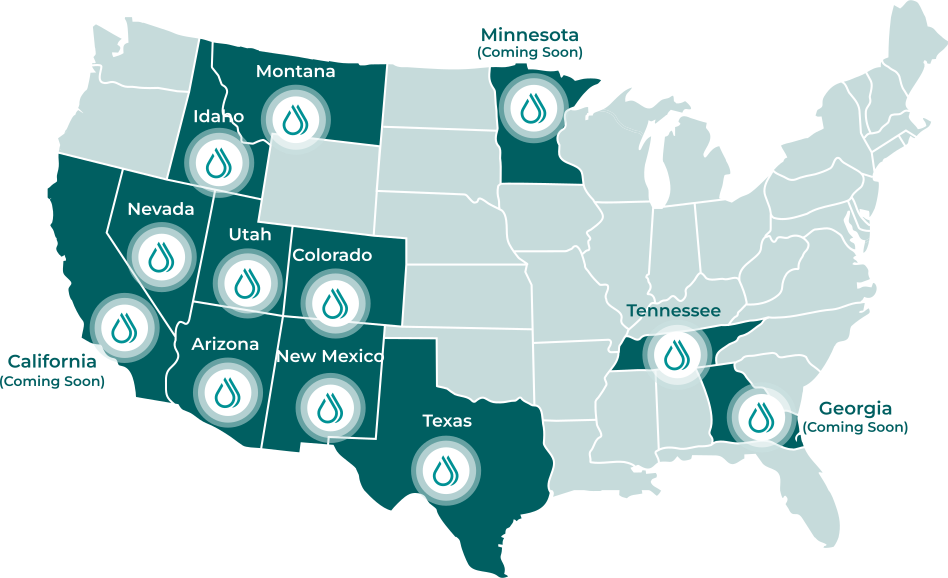
Good Faith Exams are legally required in most states before administering medical treatments, including IV therapy. The specific requirements vary by state, but the principle is consistent: a licensed provider must assess a patient's health and determine treatment appropriateness before proceeding. Pure IV follows this standard across all ten of our markets in eight states.
How is this different from a standing order?
A standing order is a general treatment protocol signed once by a physician that applies to all patients without individual review. There is no live assessment, no patient-specific evaluation, and no NP speaking with you before your treatment. Pure IV does not operate on standing orders. Instead, our Nurse Practitioner conducts a live televisit with each patient and issues a patient-specific clinical order for each appointment. Your treatment is tailored to your health, not a generic formula applied to everyone.
Your Safety Is Not Optional. It Is Not an Upsell. And It Is Not Something You Should Pay Extra For.
Most people never think about what happens before the IV starts. They book an appointment, a nurse shows up, and the treatment begins. But what happens in between, the medical screening, the live NP assessment, the vital signs, the clinical approval, is what separates a safe treatment from a risky one.
At Pure IV, every appointment includes a free, live Good Faith Exam with a Nurse Practitioner who actually speaks with you. Every treatment is specifically approved for your body, your health, and your current condition. Every provider stays with you from start to finish. And you never pay a dime for the medical screening that keeps you safe.
That is not the industry standard. That is the Pure IV standard. And we believe it should be the standard everywhere.
Ready to Try IV Therapy?
Now you know what IV therapy is, how it works, and why millions of people use it to feel their best. Whether you need fast hydration, hangover relief, immune support, or just want more energy and focus, Pure IV brings safe, physician-quality IV therapy directly to you.
Every Pure IV treatment is administered by a licensed RN or paramedic, overseen in real time by a Nurse Practitioner, and backed by transparent pricing with no hidden fees. That is our promise.
✓ Licensed nurses and paramedics ✓ Same-day appointments available
✓
No travel required
✓
Hospital-grade treatments