Cheat Sheet to Mounjaro vs Ozempic

Medically reviewed by Allison Lane, MD
Allison Lane • February 22, 2026
Table of Contents
Mounjaro vs Ozempic are two of the most talked-about medications for managing type 2 diabetes and promoting weight loss, but they work differently in your body and produce different results.
Quick Comparison:
| Feature | Mounjaro (Tirzepatide) | Ozempic (Semaglutide) |
|---|---|---|
| Mechanism | Dual GIP/GLP-1 receptor agonist | Single GLP-1 receptor agonist |
| A1C Reduction | 2.0-2.3% average | 1.9% average |
| Weight Loss | 17-25 lbs (7.7-11.4 kg) | 13 lbs (5.9 kg) |
| Dosing | 2.5 mg to 15 mg weekly | 0.25 mg to 2.0 mg weekly |
| Cost (without insurance) | ~$1,023/month | ~$936/month |
| Heart Benefits | Under study | FDA-approved for cardiovascular risk reduction |
| Pen Type | Single-use | Multi-dose (4 doses) |
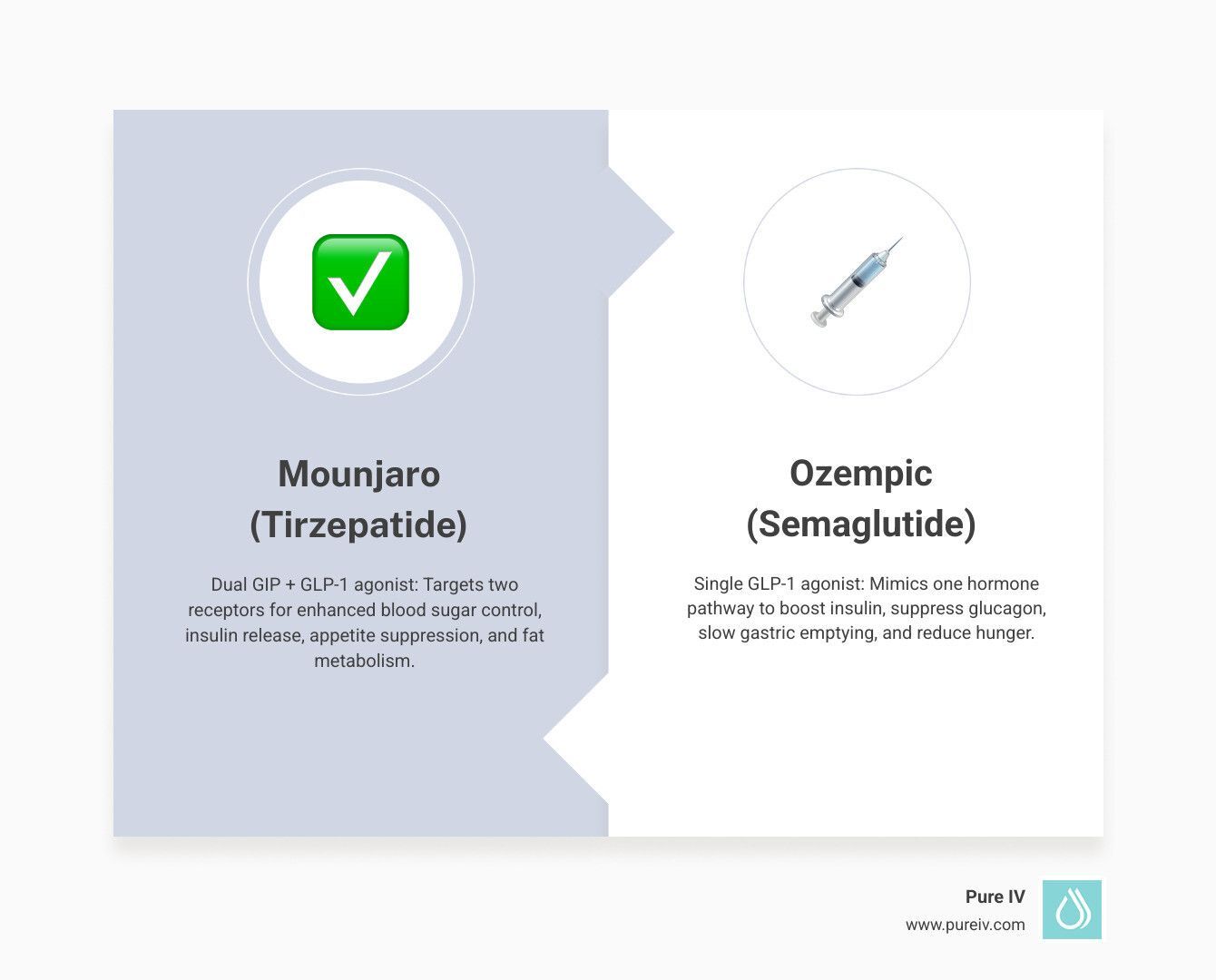
Both drugs are weekly injectable medications called incretin mimetics —they mimic natural gut hormones that regulate blood sugar and appetite. The key difference is that Mounjaro activates two hormones (GLP-1 and GIP) while Ozempic activates one (GLP-1 only).
In head-to-head studies like SURPASS-2, Mounjaro showed greater A1C reductions and more weight loss compared to Ozempic. In a 2024 real-world study of over 41,000 adults, 81.8% of people on Mounjaro lost at least 5% of their body weight within one year , compared to 66.5% on Ozempic.
But effectiveness isn't the only consideration. Ozempic is currently the only one FDA-approved to reduce heart attack and stroke risk in people with type 2 diabetes and heart disease. Cost, side effects, and your individual health goals all matter when choosing between these medications.
I'm Dr. Allison Lane , a board-certified emergency medicine physician and Medical Director at Pure IV with over 15 years of clinical experience. Throughout my career treating patients with metabolic conditions and providing medical oversight for weight management therapies, I've helped many individuals navigate the Mounjaro vs Ozempic decision based on their unique health profiles. This guide will walk you through everything you need to know to have an informed conversation with your healthcare provider.
Mounjaro vs Ozempic: Biological Mechanisms and FDA Uses
To understand the mounjaro vs ozempic debate, we have to look at the "engine" under the hood. While both are once-weekly subcutaneous injections, they belong to slightly different biochemical categories.
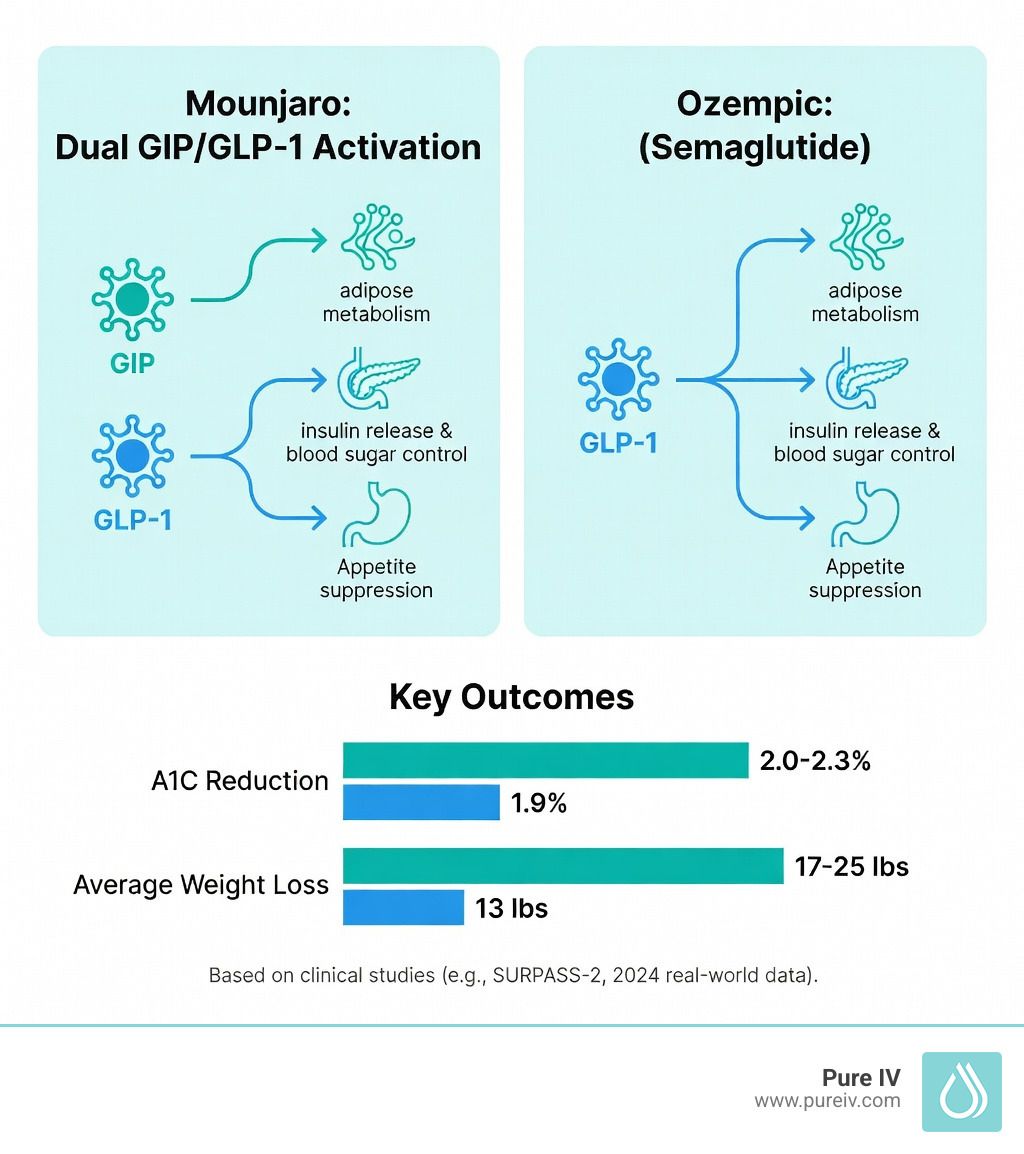
Ozempic (semaglutide) is a Glucagon-Like Peptide-1 (GLP-1) receptor agonist. It mimics the GLP-1 hormone your body naturally releases after you eat. This hormone tells your pancreas to release more insulin when blood sugar is high and tells your liver to stop producing too much glucose.
Mounjaro (tirzepatide), on the other hand, is a dual agonist. It targets the GLP-1 receptor and the Glucose-Dependent Insulinotropic Polypeptide (GIP) receptor. Think of GIP as a teammate that helps GLP-1 work better. According to the SURPASS-2 clinical trial results , this "two-pronged attack" allows Tirzepatide Weight Loss and blood sugar control to reach levels that single-hormone drugs often cannot match.
How Mounjaro vs Ozempic Affects Appetite
Both medications are famous for making people feel "full" faster, but they do this through a few different pathways. First, they slow down "gastric emptying." This means food stays in your stomach longer, physically making you feel satiated for a greater duration after a meal.
Second, they talk to your brain. These hormones cross the blood-brain barrier and target receptors in the hypothalamus, the area responsible for hunger signals and cravings. By regulating these signals, the drugs help reduce "food noise"—that constant, intrusive thought about when or what you will eat next. Because Mounjaro hits two different receptors, some clinical evidence suggests it may have a slightly stronger effect on metabolic health and fat metabolism.
FDA-Approved Indications
It is important to clarify what these specific brand names are actually approved for. Currently, both Mounjaro and Ozempic are FDA-approved specifically for the treatment of Type 2 diabetes to improve glycemic control.
However, because they are so effective at weight reduction, they are frequently prescribed "off-label" for weight management. To address this demand, the manufacturers created separate brand names with higher dosing schedules specifically for weight loss:
- Semaglutide: Ozempic (Diabetes) / Wegovy (Weight Loss)
- Tirzepatide: Mounjaro (Diabetes) / Zepbound (Weight Loss)
Clinical Efficacy: A1C Control and Weight Loss
When we look at the data, the numbers for mounjaro vs ozempic are impressive across the board. However, Mounjaro generally holds the edge in raw percentage drops.
| Clinical Metric | Mounjaro (15 mg) | Ozempic (1 mg) |
|---|---|---|
| A1C Reduction | 2.3% | 1.86% - 1.9% |
| Weight Loss (lb) | ~25 lbs | ~13 lbs |
| Participants losing >5% weight | 81.8% | 66.5% |
The Truveta real-world weight loss study , which analyzed over 41,000 adults, confirmed that tirzepatide users were significantly more likely to achieve 5%, 10%, and 15% weight loss thresholds compared to those on semaglutide.
Comparing Weight Loss Outcomes for Mounjaro vs Ozempic
In the SURMOUNT-5 trial, which specifically looked at the weight-loss versions of these drugs, Zepbound (tirzepatide) led to an average weight loss of about 20% over 72 weeks, while
Wegovy (semaglutide) saw around 14.9%.
At Pure IV, we see these results reflected in our Weight Loss Services. While Semaglutide Weight Loss is incredibly effective and remains the "gold standard" for many, Mounjaro often provides that extra push for patients who have hit a plateau or have significant metabolic resistance.
A1C Reduction Performance
For our neighbors in Phoenix, Salt Lake City, and Nashville managing diabetes, A1C is the most important number. In a meta-analysis of 22 trials involving over 18,000 participants, Tirzepatide 15 mg reduced A1C by a mean of 2.0%, while semaglutide 2 mg reduced it by 1.62%.
While a 0.4% difference might seem small, in endocrinology, that is a significant margin that can be the difference between reaching a target goal of <7% and remaining in a high-risk zone.
Side Effects, Risks, and Heart Health Benefits
No medication is a "free lunch," and both of these drugs come with a list of potential side effects. Most of these are gastrointestinal (GI) because of how the drugs slow down your digestive system.
Common side effects for both include:
- Nausea (reported by 12-20% of users)
- Diarrhea
- Vomiting
- Constipation
- Stomach pain
The Ozempic Prescribing Information and Mounjaro's label both include a "Boxed Warning" regarding thyroid C-cell tumors. While this has only been seen in rodent studies, doctors advise anyone with a personal or family history of Medullary Thyroid Carcinoma (MTC) or Multiple Endocrine Neoplasia syndrome type 2 (MEN 2) to avoid these drugs.
Gastrointestinal Tolerance
One interesting finding in the research is the "efficacy vs. side effect" trade-off. Some studies suggest that because Mounjaro is more potent, its side effects may be slightly more pronounced during the initial weeks.
However, many clinicians, including our team at Pure IV, find that tirzepatide is often better tolerated long-term because the GIP component may help "buffer" some of the GI distress caused by GLP-1. To minimize these issues, we always recommend a strict titration schedule—starting at a very low dose and gradually increasing every four weeks.
Cardiovascular Risk Reduction
This is where Ozempic currently shines. The SELECT trial proved that semaglutide reduces the risk of Major Adverse Cardiovascular Events (MACE)—like heart attack and stroke—by 20% in adults with heart disease.
While Mounjaro has shown promise in lowering blood pressure and improving lipid profiles, it does not yet have the same specific FDA approval for heart protection. If you have a history of heart disease, your doctor might lean toward Ozempic for this reason. We also keep a close eye on emerging therapies like Retatrutide Weight Loss , which is currently in trials and may offer even broader metabolic benefits.
Practical Guide: Dosing, Administration, and Cost
Both medications are administered once a week, on the same day each week, at any time of day, with or without meals.
Typical Titration Schedules:
- Ozempic: Start at 0.25 mg for 4 weeks, then 0.5 mg. If needed, increase to 1.0 mg or the max dose of 2.0 mg.
- Mounjaro: Start at 2.5 mg for 4 weeks, then 5 mg. Dose can be increased in 2.5 mg increments every 4 weeks up to a maximum of 15 mg.
Administration and Storage
Both use a tiny needle that is relatively painless. You should rotate your injection site each week between your abdomen, thigh, or upper arm.
- Mounjaro Pens: These are single-use. You throw the whole pen away after one dose.
- Ozempic Pens: These are multi-dose. One pen usually contains four doses (a one-month supply). You just click to your dose and swap the needle tip each week.
Both should be stored in the refrigerator. While they can stay at room temperature for a short period (up to 21-56 days depending on the brand), keeping them cool is best for maintaining the peptide's integrity.
Cost and Accessibility
Let’s talk about the elephant in the room: the price. Without insurance, these medications are expensive.
- Mounjaro list price: Approximately $1,023 per month.
- Ozempic list price: Approximately $936 per month.
Insurance coverage varies wildly. Most plans cover these for Type 2 diabetes but may require a "Prior Authorization." Coverage for weight loss (Wegovy/Zepbound) is less common but increasing. Many patients utilize manufacturer savings cards or programs like NovoCare Pharmacy to bring the cost down to as little as $25 or $499 per month for eligible individuals.
Frequently Asked Questions and Conclusion
At Pure IV, we believe that medication is just one tool in a larger health journey. Whether you are in Las Vegas, Denver, or Albuquerque, our mobile licensed nurses and paramedics are here to support your recovery and hydration needs as you navigate these treatments. Every treatment we provide is backed by real-time Nurse Practitioner approval, ensuring your safety is our top priority.
Can you switch between Mounjaro and Ozempic?
Yes, people switch between mounjaro vs ozempic frequently, often due to supply shortages or a desire for better results. However, you cannot simply swap a 2.0 mg Ozempic dose for a 15 mg Mounjaro dose. Because they hit different receptors, your doctor will likely have you "reset" at a lower dose of the new medication to ensure your stomach can handle the transition. Never switch without direct clinician supervision.
What is the difference between Mounjaro and Zepbound?
They are the exact same drug: tirzepatide. Eli Lilly markets them under two names for regulatory and insurance reasons. Mounjaro is labeled for diabetes, and Zepbound is labeled for obesity/weight management. The dosages and the actual medicine in the pens are identical.
Which drug is better for heart health?
Currently, Ozempic has the stronger track record and the official FDA indication for reducing cardiovascular risk. If your primary medical concern is a history of stroke or heart attack, Ozempic (semaglutide) is usually the preferred choice. Mounjaro is currently undergoing similar long-term trials to see if it can match or beat those results.
Conclusion
Choosing between mounjaro vs ozempic isn't about finding the "best" drug—it's about finding the best drug for you. If your goal is maximum weight loss and A1C reduction, Mounjaro's dual-action formula might be the winner. If you have existing heart disease or your insurance has a preferred tier for semaglutide, Ozempic is a world-class option that has changed millions of lives.
If you’re starting your journey and need support with hydration or vitamin replenishment to manage those early side effects, we’re here to help. Explore our Weight Loss Services and see how we can support your metabolic health from the comfort of your home.
Disclaimer: This article is for informational purposes only and does not constitute medical advice. Always consult with your healthcare provider before starting or switching medications.
Dr. Allison Lane is a board-certified physician who focuses on clear communication, patient safety, and personalized treatment plans. She works closely with our team to ensure care is safe based on each person’s medical history, needs, and goals. Her clinical interests include sports medicine, emergency medicine, and tactical medicine.
Dr. Lane has extensive experience providing medical support for athletes and major events. She is the Medical Director for the Tucson Roadrunners and has served as a team physician for University of Arizona athletics and multiple professional and community sports organizations. She also works as a ringside physician for boxing and MMA events.
She’s also active in community service and medical training, helping teach CPR, Narcan use, Stop the Bleed, and basic first aid. At Pure IV, Dr. Lane's focus is on medical compliance, patient safety, and helping scale Pure IV on the medical side.
Education & Training:
- University of Arizona College of Medicine (2010)
- Emergency Medicine Residency, University of Arizona (2013)
- Primary Care Sports Medicine Fellowship, University of Arizona (2014)
Recent Posts